
'We need boots on-the-ground': Nicola Barry Award winner on journalism in the age of AI
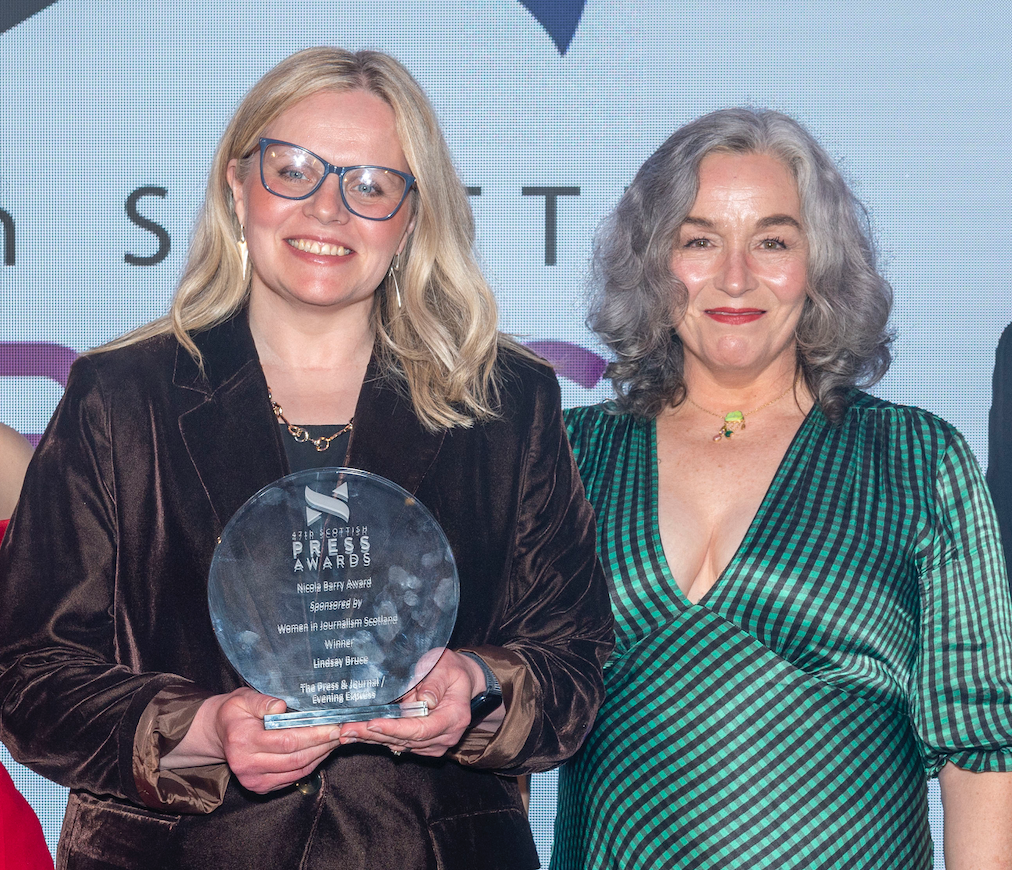
Lindsay Bruce (L) with WIJ Scotland co-chair Anna Burnside. Picture credit: @Jeff Holmes Pix
The winner of this year’s Nicola Barry Award, sponsored by WIJ Scotland at the Scottish Press Awards, was Lindsay Bruce of The Press and Journal / Evening Express for her coverage of Aberdeen’s RAAC concrete crisis, which you can read more about here.
Here Lindsay reflects on winning the award and the highs and lows of modern journalism.
In the age of AI, and all the necessary chat about what it means for news brands and reporters, I have a conviction: boots-on-the-ground, “old fashioned” journalism has never been more necessary.
Receiving this year’s Nicola Barry Award, after two years covering Aberdeen’s never-ending RAAC concrete crisis, interviewing scores of people and submitting more FOIs than I care to recall, was incredibly humbling.
Ahead of this year’s Scottish Press Awards, my colleague and friend Sally McDonald of the Sunday Post asked me if I knew “Nickers”. Great friends for years before Nicola’s untimely death, Sally told me she would have loved our Press and Journal Trapped by RAAC campaign.
“Nicola would have been all over that,” she said.
Hearing my name alongside hers was such a surprise, especially given the incredible women I was nominated alongside.
And can I add, imposter syndrome is real, let me tell you.
But I can’t say I’m not ridiculously proud to be among those fortunate enough to do the kind of journalism we all dreamt about as trainees, students and juniors. The kind of journalism Nicola Barry was known for.
I love that legacy we have in Scotland of fiercely determined, justice-driven female reporters, writers and news gatherers. Incredible women run in our family – and may we never forget it. Like the fight against AI, we need the voices of women with integrity in our media and in this nation of Scotland now more than ever.
That said, I’m sure I’m not alone in spending most of my time these days having far fewer moments of calling power to account, and increasingly more tasks that drive dashboard figures or spike newspaper sales.
I get it. It’s the job.
As part of the features team at The P&J, my list this week included visiting a cooperage, writing about someone’s wedding, having a brain scan for a health feature, doing two obits and tracking down couples who met “at the dancing” in the 1950s.
Genuinely, is there any job like this?
Two years ago, however, the journalism stars aligned for me.
At a church service in Balnagask, Torry, three women shared that they were going to be displaced because of RAAC in their council houses, and two families told me they were facing bankruptcy because their forever homes were now deemed almost worthless due to unstable concrete in their roofs.
Through no fault of their own, they had been plunged into chaos and uncertainty.
That’s where my journey towards leading our Trapped by RAAC campaign began.
It started by being in the community and listening to real people. They would never have called me. And AI could never find and elevate their desperate voices.
From that day I pitched the idea of setting up camp in a Balnagask community centre and seeing who turned up to talk. The coverage from those two days, and the never-ending queue that formed around me, was what I submitted for last year’s Nicola Barry Award, when I received the runner-up prize.
That one exercise highlighted plummeting house values, fear and anxiety, women’s safety concerns and a community on the brink of despair.
In a nutshell, because the roofs could collapse at any moment, the houses were condemned. Private homeowners could either fix their homes at huge cost or sell them back to the council at dramatically reduced values.
Neither was a realistic option.
While our City and Politics teams continued covering council meetings and government discussions, I asked if I could keep focusing on the families facing homelessness, bankruptcy and an ever-worsening mental health crisis.
To my dismay, no amount of heartbreaking stories seemed to shift the dial.
Stories like that of 80-year-old army veteran and widower Charlie Walker, in tears as he worried he would end up on the streets.
Without pre-RAAC valuations on homes already earmarked for demolition, the future looked bleak. We even heard reports of one father considering driving his car into the harbour.
So in March 2025 I asked my editor if we could tip our RAAC reporting from coverage into campaigning.
Despite how insurmountable the task seemed, he agreed.
What followed, beginning in April, was six weeks of daily case studies, investigations and hard-hitting interviews, followed by weekly updates to keep the issue in the headlines.
It meant interviewing around 90 people, publishing more than 40 articles, including 16 exclusives, pressing politicians, and walking miles asking businesses and residents to display campaign posters.
It meant using my house for campaign meetings, Sunday-night pub gatherings with hundreds of families, on-street protests, endless spreadsheets and even speaking in council chambers.
We hosted a Question Time event in our newsroom, allowing homeowners and politicians to go head-to-head, and we relentlessly, compassionately and forensically did all we could to argue for fair house prices.
Then, on October 27, 2025, I had the privilege of messaging my editor: “They’re going to give homeowners the pre-RAAC values of their homes!”
He replied: “Wait… does that mean we won?”
That same night I went to the pub with my RAAC families and, over a gifted Irn-Bru, we celebrated the shared victory.
I don’t share any of this to be boastful, or to suggest I did anything you all don’t do every single day.
I keep telling this story because journalism – and in my case regional journalism – matters.
What we do matters.
It can still change lives.
It can still save lives.
It can still reverse injustice, challenge attitudes, reveal reality and force change.
And what’s more, it’s a privilege.
2025 was genuinely the most fulfilling – and exhausting – year of my career, and I’ve been doing this since I was 18.
Not every year will reap awards and big wins, and not every assignment will be as much fun – or as high pressure – as helping a community campaign.
But if I could offer any encouragement, it would simply be this: keep doing what only we can do.
Get out there.
Talk to people.
Listen.
And give a voice to those who don’t have the amazing platform we do.
In an age of AI, whenever we can, be boots-on-the-ground.